Variation of Intensity with Vocal Tract Adjustments
While lung pressure and glottal adduction provide the primary mechanisms for intensity control, adjustments of the vocal tract configuration offer a third, highly sophisticated method for varying the acoustic output of the voice. By modifying vocal tract shape, speakers and singers can selectively amplify certain harmonics of the glottal source, producing substantial changes in radiated intensity without altering aerodynamic parameters.
The Vocal Tract as a Resonator
Transfer Function and Formants
The vocal tract functions as an acoustic filter that modifies the spectrum of the glottal source. This filtering action is characterized by the vocal tract transfer function, which describes how the vocal tract amplifies or attenuates different frequencies.
Formants represent the resonance frequencies of the vocal tract—frequencies at which the tract offers maximum acoustic transmission. At formant frequencies, the vocal tract can boost harmonics of the glottal source by 10-20 dB or more, creating prominent spectral peaks in the radiated sound.
The relationship between source and filter can be expressed as:
P_radiated(f) = U_glottal(f) × T_VT(f) × R(f)where:
- P_radiated(f) = radiated sound pressure at frequency f
- U_glottal(f) = glottal source spectrum
- T_VT(f) = vocal tract transfer function
- R(f) = radiation characteristic
This source-filter model demonstrates that radiated intensity depends not only on source strength but also on how effectively the vocal tract transmits the source energy.
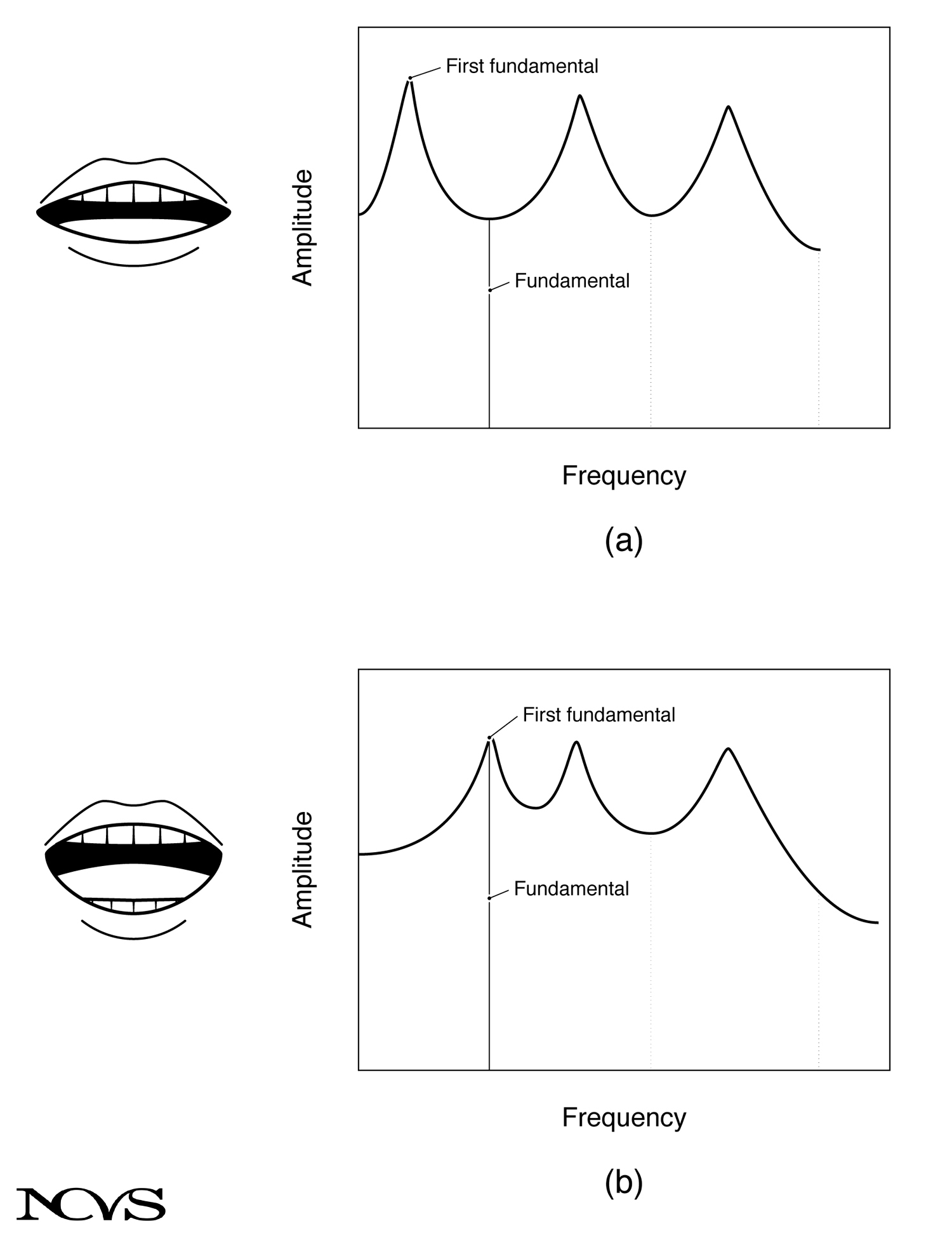 Figure 9.6: The vocal tract transfer function showing formant peaks (F₁, F₂, F₃) that can amplify harmonics of the glottal source by 10-20 dB. Strategic alignment of formants with strong harmonics maximizes radiated intensity.
Formant Bandwidth and Peak Gain
The bandwidth of a formant determines how sharply tuned the resonance is. Narrower bandwidths produce:
- Higher peak gains (greater amplification)
- More selective frequency response
- Greater potential for boosting individual harmonics
Formant bandwidths typically range from 50-100 Hz for F₁ to 100-200 Hz for higher formants. The peak gain at a formant frequency can be estimated from:
Gain (dB) ≈ 20 log₁₀(F_i / BW_i)where:
- F_i = formant frequency
- BW_i = formant bandwidth
Narrower bandwidths allow more precise tuning of formants to specific harmonics, maximizing the energy transfer from source to radiated sound.
Formant-Harmonic Interaction
Alignment Strategies
When a formant frequency aligns closely with a harmonic of the fundamental frequency, that harmonic receives maximum amplification. The total radiated intensity depends on:
- Source harmonic strength: Determined by glottal waveform shape
- Formant proximity: How close the formant is to the harmonic
- Formant bandwidth: How sharply tuned the resonance is
- Number of formant-harmonic alignments: Multiple alignments produce greater total energy
Speakers can manipulate these factors by:
- Adjusting vocal tract shape to move formants
- Modifying fundamental frequency to move harmonics
- Changing glottal configuration to alter harmonic structure
The Vowel Effect
Different vowels produce characteristically different formant patterns:
High Vowels (/i/, /u/):
- F₁ low (200-300 Hz)
- Limited energy in low-frequency region
- Generally lower overall intensity
Low Vowels (/a/, /æ/):
- F₁ high (700-1000 Hz)
- Strong low-frequency energy
- Generally higher overall intensity
This explains why vocal warm-up exercises often use open vowels like /a/—they naturally facilitate greater acoustic output. Conversely, achieving high intensity on vowels like /i/ requires more sophisticated strategies.
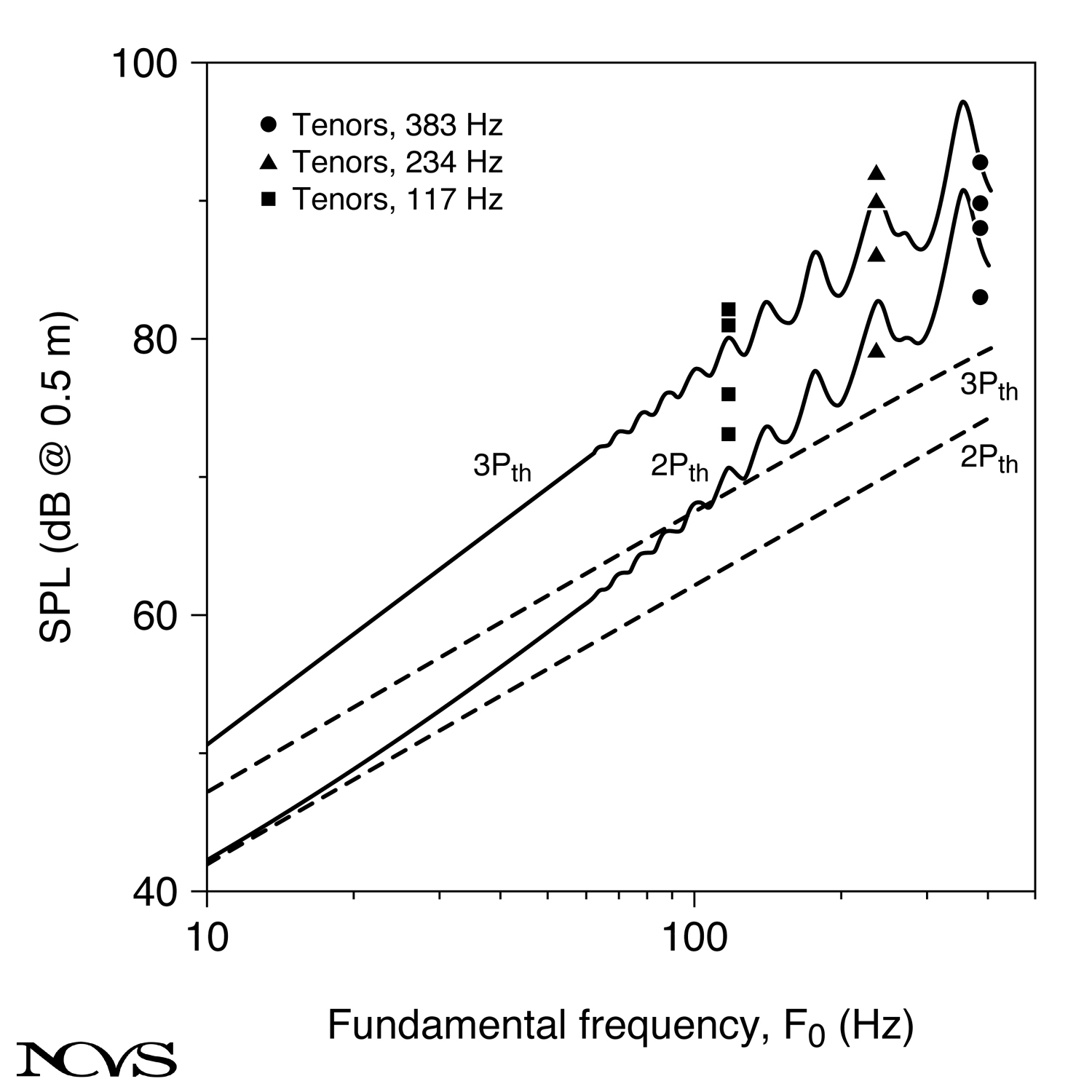 Figure 9.7: Formant frequency patterns for different vowels showing how F₁ and F₂ positions affect spectral energy distribution and overall intensity.
Formant Tuning in Singing
Strategic Formant Adjustment
Trained singers, particularly in classical and operatic traditions, develop the ability to adjust formant frequencies to optimize intensity across their pitch range. This formant tuning involves:
Vowel Modification: Subtly altering vowel quality to move formants toward strong harmonics. For example:
- Shifting /i/ toward /ɪ/ to raise F₁
- Opening /u/ toward /ʊ/ to increase F₁
- Modifying /æ/ toward /ɑ/ at high pitches
Lip and Jaw Adjustments:
- Lip rounding lowers all formants
- Jaw opening raises F₁, affects F₂
- Lip spreading raises formants
Tongue Positioning:
- Tongue advancement raises F₂
- Tongue backing lowers F₂
- Tongue height affects F₁ inversely
F₁-H₁ Tuning
At fundamental frequencies above approximately 300 Hz (approaching the soprano passaggio), the fundamental (H₁) rises into the frequency region normally occupied by F₁. Singers can choose to:
Track H₁ with F₁: Adjust vocal tract shape to keep F₁ aligned with the rising fundamental. This strategy:
- Maximizes acoustic output
- Requires progressive vowel modification
- May compromise vowel intelligibility at very high pitches
Maintain Vowel Identity: Keep F₁ at its normal frequency for vowel recognition. This strategy:
- Preserves text clarity
- Reduces intensity as F₀ rises above F₁
- Becomes unsustainable at very high pitches
Most sopranos adopt F₁-H₁ tuning above approximately E₅ (660 Hz), accepting vowel modification as necessary for adequate projection.
 Figure 9.8: Illustration of F₁-H₁ tuning strategy in soprano singing, showing how F₁ is adjusted to track the rising fundamental frequency for maximum acoustic output at high pitches.
F₁-H₂ Tuning in Male Voices
Male classical singers often employ F₁-H₂ tuning in the upper part of their range, aligning F₁ with the second harmonic rather than the fundamental. This strategy:
- Boosts the second harmonic significantly
- Creates a brighter, more “ringing” timbre
- Contributes to the characteristic sound of trained tenor voice
- Works particularly well in the passaggio region (D₄-G₄)
The choice between H₁ and H₂ tuning depends on:
- Fundamental frequency relative to normal F₁ range
- Desired timbre (warm versus brilliant)
- Text intelligibility requirements
- Musical style conventions
The Singer’s Formant Cluster
Spectral Characteristics
One of the most distinctive features of trained Western classical singing is the singer’s formant or singer’s formant cluster—a prominent spectral peak in the region of 2,000-3,000 Hz. This acoustic signature:
- Appears in all vowels during trained singing
- Increases radiated intensity by 10-20 dB in the 2-4 kHz region
- Enables singers to project over orchestral accompaniment
- Develops with training in classical vocal technique
 Figure 9.9: Spectral comparison showing the prominent singer’s formant peak around 2.8 kHz in trained singing (red) compared to speech (blue). This peak enhances projection and carrying power.
Anatomical Source
The singer’s formant arises from a clustering of the third, fourth, and fifth formants (F₃, F₄, F₅) in a narrow frequency band. This clustering results from:
Epilaryngeal Narrowing: Constriction of the epilaryngeal tube (the region just above the vocal folds) creates a two-tube resonator system:
- Lower tube: main pharyngeal-oral cavity
- Upper tube: narrow epilaryngeal tube
This configuration causes F₃, F₄, and F₅ to converge toward a common frequency determined primarily by the epilaryngeal tube length and cross-sectional area.
Optimal Dimensions:
- Epilaryngeal tube length: approximately 3-4 cm
- Epilaryngeal cross-section: approximately 1.5-2.5 cm²
- Resulting cluster frequency: 2,500-3,000 Hz (typical for male voices)
Perceptual and Acoustic Advantages
The singer’s formant provides several benefits:
Acoustic Projection:
- The 2-3 kHz region suffers minimal absorption in air
- Orchestra has relatively low energy in this frequency band
- Concert hall acoustics typically enhance this frequency region
- The human ear is maximally sensitive around 2-4 kHz
Perceived Loudness: Even without increasing total acoustic power, concentrating energy in the 2-3 kHz region:
- Increases perceived loudness due to ear sensitivity
- Enhances voice “ring” and brilliance
- Improves intelligibility in reverberant spaces
- Increases “carrying power” at a distance
Training Marker: The presence and strength of the singer’s formant:
- Distinguishes trained from untrained voices
- Correlates with years of classical vocal training
- Serves as an objective measure of technique development
- Differs characteristically between vocal classifications (bass, tenor, soprano, etc.)
Gender and Voice Type Variations
The singer’s formant manifests differently across voice types:
Male Voices:
- Clear, distinct peak around 2,500-3,000 Hz
- More prominent in tenors than basses
- Strengthens with training
- Present across all vowels
Female Voices:
- Less distinct as a separate peak
- Often merged with F₃ and F₄ rather than a separate cluster
- Centers around 3,000-3,500 Hz
- May be less prominent than in male voices due to higher F₀
Alto Voices:
- Intermediate characteristics
- Variable prominence depending on individual anatomy and training
Intensity Effects of Vocal Tract Length Changes
Lengthening Strategies
Increasing vocal tract length lowers all formant frequencies proportionally:
Techniques:
- Lip protrusion
- Lowered larynx position
- Pharyngeal expansion
Acoustic Effects:
- Formants shift to lower frequencies
- Better alignment with lower harmonics at low F₀
- “Darker” or “warmer” timbre
- Potentially greater intensity at low pitches
Shortening Strategies
Decreasing vocal tract length raises formant frequencies:
Techniques:
- Lip spreading (smile)
- Raised larynx position
- Tongue advancement
Acoustic Effects:
- Formants shift to higher frequencies
- Better alignment with higher harmonics
- “Brighter” or “more forward” timbre
- Potentially greater intensity at high pitches with appropriate vowels
Resonance Strategies Across Styles
Classical Singing
Classical technique emphasizes:
- Singer’s formant development
- Formant tuning for maximum projection
- Relatively stable larynx position
- Pharyngeal expansion for resonance
These strategies optimize:
- Projection over orchestra without amplification
- Sustained intensity over long phrases
- Timbral consistency across range
- Maximum acoustic efficiency
Contemporary Commercial Music (CCM)
Contemporary styles often employ:
- Higher larynx positions
- Less pharyngeal expansion
- Variable vowel modification strategies
- Electronic amplification
These approaches facilitate:
- Speech-like quality preferred in popular genres
- Close-microphone techniques
- Genre-specific timbral characteristics
- Flexibility across wide stylistic range
Belt Singing
Belt technique specifically uses:
- Elevated larynx position
- Strong medial compression
- High F₁ values (maintained high even at high pitches)
- Thyroarytenoid-dominant vocal fold configuration
Resulting in:
- Very high intensity output
- Bright, “brassy” timbre
- Strong presence in amplified contexts
- Characteristic musical theatre sound
Practical Applications
Assessment and Training
Understanding vocal tract effects enables:
Diagnostic Insight:
- Acoustic analysis reveals formant patterns
- Comparison with normative data identifies inefficiencies
- Spectral analysis tracks development of singer’s formant
- Intensity measurements across vowels reveal formant effects
Pedagogical Strategies:
- Teaching vowel modification for intensity optimization
- Developing awareness of resonance sensations
- Training formant tuning skills
- Building singer’s formant through specific exercises
Repertoire and Performance
Professional application includes:
Musical Demands:
- Choosing appropriate resonance strategies for style
- Managing intensity across different vowel sequences
- Compensating for suboptimal vowel-pitch combinations
- Adapting to different acoustic environments
Efficiency and Health:
- Using resonance rather than pressure for intensity
- Reducing laryngeal effort through optimal formant tuning
- Balancing projection with long-term vocal health
- Strategic use of vocal tract adjustments for sustainability
Summary
Vocal tract adjustments provide a sophisticated third mechanism for intensity control, operating through the strategic alignment of formants with harmonics of the glottal source. The vocal tract transfer function can boost selected harmonics by 10-20 dB, producing substantial changes in radiated intensity without altering lung pressure or glottal configuration.
Trained singers develop the ability to tune formants to maximize acoustic output across their pitch range, employing strategies such as F₁-H₁ tuning in sopranos and F₁-H₂ tuning in male voices. The singer’s formant cluster, arising from epilaryngeal narrowing, provides a characteristic 10-20 dB boost in the 2-3 kHz region, enabling projection over orchestral accompaniment.
Understanding vocal tract effects on intensity enables more sophisticated clinical assessment, more effective pedagogical guidance, and more informed choices about intensity production strategies in diverse communicative and artistic contexts. The ability to vary intensity through resonance adjustments, rather than solely through increased pressure or laryngeal effort, represents a hallmark of efficient, healthy voice production.
Key Takeaways
- ✅ Vocal tract formants can amplify selected harmonics by 10-20 dB, substantially affecting radiated intensity
- ✅ Formant tuning involves adjusting vocal tract shape to align formants with strong harmonics for maximum energy transfer
- ✅ F₁-H₁ tuning (aligning first formant with fundamental) is crucial for sopranos at high pitches
- ✅ The singer’s formant cluster around 2-3 kHz enables classical singers to project over orchestras
- ✅ Singer’s formant arises from epilaryngeal narrowing that clusters F₃, F₄, and F₅
- ✅ Different vowels have inherently different intensity capabilities due to formant patterns
- ✅ Vocal tract adjustments offer an efficient intensity control mechanism that minimizes laryngeal stress
Related Topics
- Some Definitions of Terms
- Variation of Intensity with Adduction, Lung Pressure, and F₀
- Vocal Efficiency
- Source-Filter Theory
- Vocal Registers
Further Reading
- Sundberg, J. (1974). Articulatory interpretation of the “singing formant”. Journal of the Acoustical Society of America, 55(4), 838-844.
- Joliveau, E., Smith, J., & Wolfe, J. (2004). Tuning of vocal tract resonances by sopranos. Nature, 427(6970), 116.
- Story, B. H., Titze, I. R., & Hoffman, E. A. (1996). Vocal tract area functions from magnetic resonance imaging. Journal of the Acoustical Society of America, 100(1), 537-554.
- Sundberg, J. (1987). The science of the singing voice. DeKalb, IL: Northern Illinois University Press.
- Miller, D. G. (2008). Resonance in singing: Voice building through acoustic feedback. Princeton, NJ: Inside View Press.